
I am a regular traveler to Texas, and on a recent trip I brought my family along so they could see the sights and meet the people of my expanded community and environment. As many times as I have driven through Dallas, I have never been able to stop at one of the places that has always interested me: the Perot Museum. I will just come right out and say it: I am a sucker for natural history museums, especially dinosaurs. The Perot Museum is an excellent museum and delivered on the dinosaurs. However, you are not here to read my museum reviews, so I will get on with it.
Now normally, if you find yourself wandering through a museum trying to learn something new, keeping tabs on your kids, or maybe thinking about what's for lunch, there might still be a small part of your brain that's thinking about embalming. On this trip to the Perot Museum, I could certainly hear that little voice, and it came to a roar when I came face to face with the fossil of the mighty Tylosaurus rex.
The Tylosaurus rex is a species of mosasaur, the giant marine reptile featured in the Jurassic World movies. They lived during the Late Cretaceous period and proliferated in North America in the large inland sea that existed during that time, and their fossils were discovered near Dallas.
I know, I know, this is an article about embalming, not paleontology. You may have already noticed the words "Ocean Life in Dallas" on the glass in the picture. This is when the embalming thoughts grew louder.
Examine, if you will, the map below of North America during the time of Tylosaurus rex, with modern-day North America shaded underneath.
Also note the cleverly placed cowboy hat indicating the approximate location of present-day Dallas, and you will understand why the exhibit indicated ocean life in Dallas. In fact, you may notice that much of modern-day North America was underwater, all the way from north of my hometown in Chicagoland through Mexico.
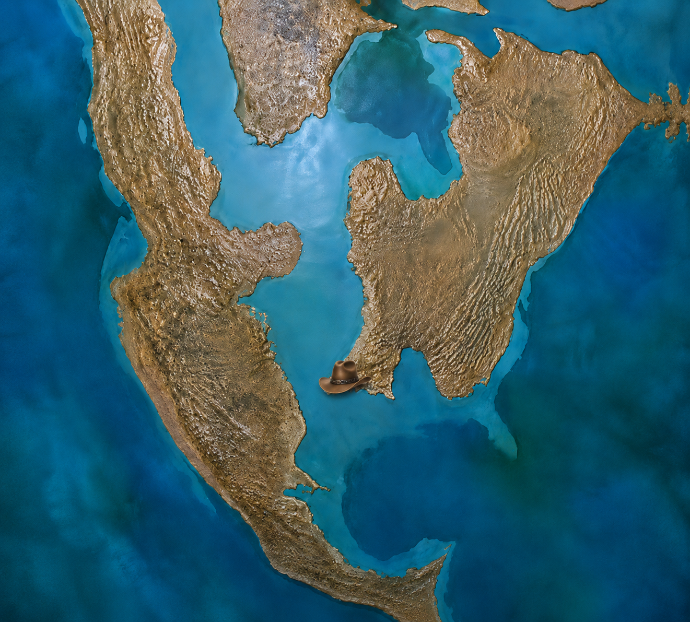
Now, you may be thinking, "What does an inland sea and an impressive apex predator from 77 million years ago have to do with embalming?" A fair point. What this inland sea did was create some of the hardest water in the world. Billions of marine organisms lived in that inland sea, and their bones and shells were made up of calcium carbonate and magnesium-rich minerals. Over time, these materials accumulated on the sea floor, creating modern-day limestone, shale, and dolomite. Groundwater passes through these layers and dissolves calcium and magnesium ions. The scale buildup and mineral deposits on equipment and fixtures are a direct result of this prehistoric ecosystem.
This is something the modern-day embalmer should register because hard water can greatly impede our embalming process by reducing the effectiveness of formaldehyde, interfering with dyes and other modifying agents, and reducing overall penetration and diffusion. The word "calcium" should also be as concerning as a raptor in the bushes, as calcium is responsible for the blood-clotting reactions.
Consider all the opportunities this ancient hard water creates to interfere with your embalming. First, as already identified, it is in your water system. This then enters your funeral home pipes and accumulates. Even in a newer funeral home, your pipes are clearer of buildup, but it is still there. If you are in an older one, your pipes could be more clogged than a Tyrannosaurus after an all-you-can-eat Triceratops buffet. Then you put that water into your embalming machine. Because I am sure you have read your owner's manual, you will know that most of them prompt you to leave some standing water in your machine. The water will evaporate, but the hard water particles do not, and they can compound the hard water situation over time.
So how do we fix this? Number one, use a water conditioner. Many arterial fluids already contain chemicals like EDTA and citrates because they help balance pH to aid the formaldehyde. However, these types of chemicals also act as hard water sequestrants. This may not be enough, and that's where supplemental chemicals come in. The best place to find information about your water treatment chemicals is to read your Safety Data Sheets. Even though they are more boring than watching continental drift, they can tell you how your fluids work and help you determine whether they fit your needs. The second thing we need to do is machine maintenance. Flushing your machine with a water conditioner and cleaning the filter can go a long way toward improving the quality of your embalming. If you are seeing splotchiness or other signs of uneven diffusion, you might have hard water particle buildup in your machine. I will also add that leaving standing arterial solution in your machine will degrade the fittings faster, adding more particles to your injection, so just stick with water and water conditioners.
And that, my friends, is how the existence of a 77-million-year-old fossil can alert you to problems you might be having in your prep room. Next time you are walking through a museum, go beyond the mummification exhibits and consider what else that museum can tell you about your prep room and your embalming habits.